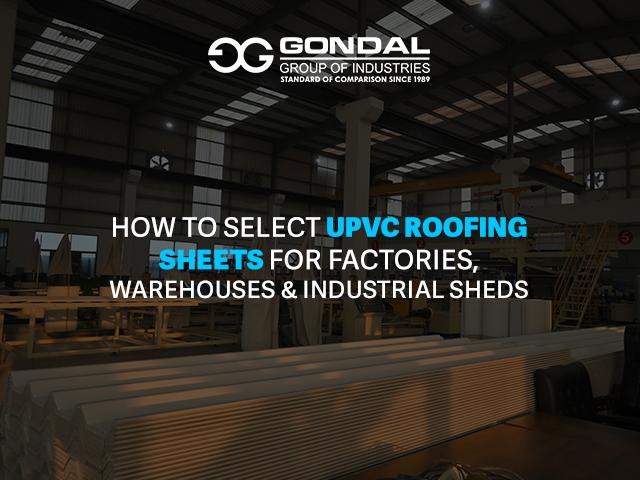

Selecting roofing for a factory, warehouse, or industrial shed is not simply a matter of choosing the strongest-looking sheet. The roof must perform under heat, UV exposure, rain, humidity, dust, industrial pollutants, and daily operational conditions. It also needs to work with the building’s structural design, drainage system, ventilation requirements, and maintenance strategy.
This is why how to select uPVC roofing sheets should be approached as a complete performance decision rather than a simple product comparison.
Gondal Group’s previous roofing guides highlight several factors that consistently affect industrial roofing performance, including sheet thickness, climate resistance, insulation, drainage, installation quality, and long-term maintenance.
1. Start With the Building’s Purpose
The first step is to understand what the building will be used for.
A warehouse storing general goods may have different requirements from a food-processing plant, chemical facility, manufacturing unit, or logistics centre. Consider:
- Expected indoor temperature requirements
- Chemical or industrial exposure
- Humidity and moisture levels
- Required ventilation
- Equipment installed below the roof
- Storage height and available clearance
- Expected maintenance access
- Future expansion plans
For example, a facility that operates machinery throughout the day may place greater importance on thermal insulation and ventilation, while a warehouse may place greater emphasis on weather protection, durability, and low maintenance.
2. Choose the Right uPVC Sheet Profile
Profile is an important part of how to select uPVC roofing sheets because the shape of the sheet influences rigidity, water drainage, and suitability for different structures.
Gondal Group currently lists three primary uPVC sheet options: S-type single sheets, low-ridge corrugated sheets, and high-ridge corrugated sheets.
The appropriate profile depends on the roof design, span, supporting structure, environmental conditions, and required performance.
High-ridge profiles, for example, can provide additional rigidity, while corrugated designs help channel rainwater away from the roof surface. Gondal Group's earlier application guide also identifies high-ridge twin-wall corrugated sheets for commercial and industrial roofing and cladding applications.
3. Pay Attention to Sheet Thickness
Thickness should never be selected independently from the structural design.
As discussed in Gondal Group's uPVC roofing sheet thickness guide, thinner sheets may suit lighter applications, while medium-thickness sheets can provide a useful balance for warehouses, manufacturing facilities, workshops, and distribution centres.
For a factory or large industrial shed, consider:
- Roof span
- Purlin spacing
- Wind exposure
- Rainfall
- Installation method
- Expected maintenance access
- Local environmental conditions
The goal is not necessarily to purchase the thickest sheet available. It is to select a thickness appropriate for the building and support system.
4. Consider Pakistan's Climate
Climate should be one of the biggest factors in how to select uPVC roofing sheets for an industrial project in Pakistan.
Industrial buildings may experience intense summer heat, strong sunlight, monsoon rainfall, humidity, dust, and, depending on location, coastal or industrial atmospheric exposure.
Gondal Group's previous roofing research specifically recommends considering UV stability, corrosion resistance, thermal insulation, ventilation, and drainage when selecting roofing for Pakistan's conditions.
For factories in hotter regions, thermal performance becomes particularly important. A roofing system that limits heat transfer can contribute to a more manageable indoor environment and potentially reduce dependence on mechanical cooling.
5. Look Beyond the Sheet and Evaluate the Complete Roofing System
One common mistake is to compare sheets while ignoring the components that make the roofing system work.
A complete industrial roofing system may require:
- Appropriate fasteners
- Sealants
- Ridges
- Gutters
- Trims
- Flashings
- Closures
- Supporting angles or structural components
- Proper drainage arrangements
Gondal Group's earlier uPVC roofing guidance also identifies gutters, fixings, sealants, trims, flashings, and ventilation components as important parts of a complete roofing solution.
A high-quality sheet cannot compensate for poor detailing around joints, edges, penetrations, or drainage points.
6. Evaluate Resistance to Corrosion, UV and Moisture
Industrial roofing can be exposed to conditions that quickly reveal weaknesses in conventional materials.
uPVC does not rust or corrode in the same way as metal roofing, making corrosion resistance particularly relevant in humid, industrial, or chemically exposed environments. Gondal Group's earlier comparison of uPVC with traditional roofing materials highlights corrosion resistance, thermal performance, weather resistance, and reduced maintenance as important advantages.
However, buyers should still verify the actual specifications, manufacturing quality, UV protection, warranty terms, and installation requirements of the selected product.
7. Compare Long-Term Cost, Not Just Purchase Price
The cheapest sheet is not necessarily the most economical roofing solution.
A proper cost comparison should consider:
Initial material cost + structural requirements + installation + maintenance + repairs + energy performance + expected service life.
Gondal Group's previous comparison of uPVC, metal, and concrete roofing similarly emphasizes that initial price should be evaluated alongside maintenance, installation, energy efficiency, and long-term performance.
This approach is particularly important for factories and warehouses where roof repairs can disrupt operations.
8. Check the Manufacturer and Installation Support
Even a technically suitable roofing sheet can perform poorly if it is manufactured inconsistently or installed incorrectly.
When evaluating a supplier, ask about:
- Manufacturing technology
- Product quality controls
- Available profiles and thicknesses
- Customisation options
- Warranty coverage
- Installation guidance
- Accessories
- Delivery capability
- Experience with industrial projects
Gondal Group's uPVC production facilities use dedicated production technology and quality-focused manufacturing processes, while its product range includes different sheet profiles for different applications.
A Practical Checklist Before Ordering
If you are still deciding how to select uPVC roofing sheets, answer these questions before placing an order:
- What is the building's primary use?
- What temperatures and weather conditions will the roof experience?
- What sheet profile suits the structural design?
- What thickness is appropriate for the support spacing and application?
- How will rainwater be collected and discharged?
- What level of UV, moisture, and corrosion resistance is required?
- What accessories and fixing system will be used?
- What are the expected maintenance requirements?
- Does the supplier have experience with similar industrial projects?
- What is the total lifecycle cost rather than only the material price?
Conclusion
Knowing how to select uPVC roofing sheets means looking at the entire roofing system rather than choosing a sheet based only on thickness or price. Profile, structural requirements, climate, thermal performance, drainage, installation, product quality, and long-term maintenance all influence the final result.
Gondal Group's previous roofing resources consistently point toward the same principle: the right roofing solution is one that matches the building's actual requirements and Pakistan's demanding environmental conditions. Its current uPVC range includes S-type single, low-ridge corrugated, and high-ridge corrugated sheets, giving industrial projects different options based on their design and performance needs.