
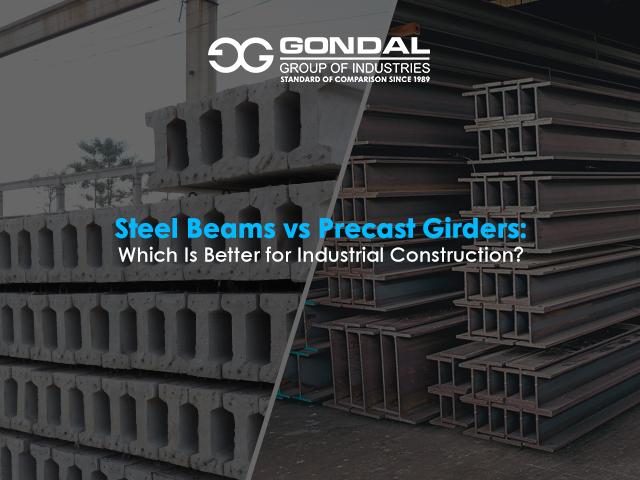
Choosing the right structural system is one of the most important decisions in industrial construction. Factories, warehouses, production facilities, and logistics buildings must support substantial loads while also meeting requirements for construction speed, durability, usable space, and future adaptability.
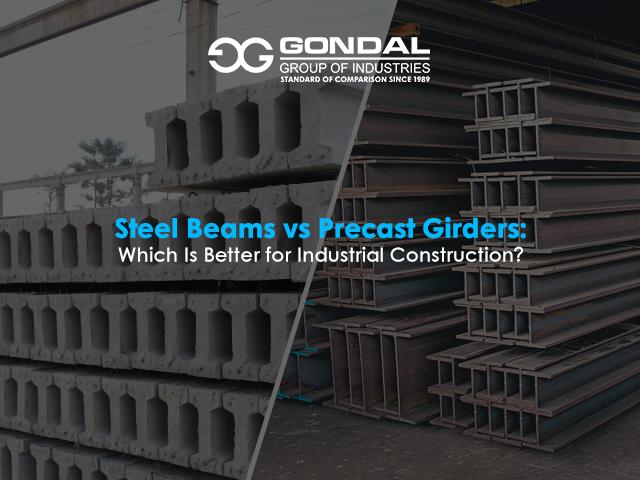
Steel beams and precast concrete girders are both proven structural solutions, but they offer different advantages. There is no universal winner. The better option depends on the building's span, loading conditions, construction schedule, site requirements, and long-term operating environment.
Understanding Steel Beams and Precast Girders
Steel beams are fabricated structural members used to transfer loads through a building's frame. Their relatively high strength-to-weight ratio makes them particularly useful where long spans, lighter structures, and flexible layouts are required.
Precast girders are reinforced or prestressed concrete members manufactured in controlled factory conditions before being transported to the construction site. They can provide substantial load-bearing capacity and consistent quality while reducing the amount of concrete work required on-site.
Both systems shift significant construction activity away from the project site, but their installation and handling requirements differ.
Construction Speed: Which Has the Advantage?
Steel beams can offer very fast erection because individual members are comparatively lightweight and can be connected efficiently using bolted or welded connections. This makes steel particularly attractive when a project has a demanding construction schedule.
Precast girders also accelerate construction because they arrive at the site ready for installation. Once foundations and supporting elements are prepared, cranes can position the girders without waiting for on-site concrete to be cast and cured.
For either system, however, the real time savings depend heavily on manufacturing capacity, transportation, site access, crane availability, and the coordination between design and installation teams.
Comparing Load-Bearing Performance
Both steel beams and precast girders can be engineered to support demanding industrial loads.
Steel provides a high strength-to-weight ratio and can be particularly efficient for long spans or structures where reducing dead load is important. Precast concrete, meanwhile, provides considerable compressive strength and can be engineered for substantial structural loads.
The appropriate solution depends on the actual loading requirements. Engineers need to consider dead and live loads, equipment loads, wind effects, span lengths, support conditions, and serviceability requirements before selecting a structural member.
Weight and Foundation Requirements
One important difference is the weight of the structural system.
Steel members are generally lighter than comparable concrete members. Depending on the soil conditions and overall structural design, this may reduce the demands placed on foundations and make transportation and handling easier.
Precast girders are heavier, which means transportation and lifting require careful planning. However, their mass can also contribute to characteristics such as stiffness and structural stability.
Foundation design should therefore be based on the complete structural system rather than the beam or girder alone.
Large-Span Industrial Applications
Industrial facilities frequently require large open areas without columns obstructing production lines, storage racks, or vehicle movement.
Steel beams are well suited to large-span applications because their strength-to-weight ratio allows engineers to design efficient structural frames.
Precast girders can also be highly effective for large-span construction, particularly where repetitive components can be manufactured efficiently and installed according to a coordinated schedule.
The best choice ultimately depends on the required span, structural loads, available equipment, and overall building design.
Durability and Maintenance
Long-term performance is another important consideration.
Steel requires appropriate corrosion protection, particularly when exposed to moisture, humidity, chemicals, or coastal conditions. Protective coatings and periodic inspections can help maintain its performance.
Precast concrete is naturally resistant to many environmental conditions, although its durability depends on concrete quality, reinforcement detailing, exposure conditions, and manufacturing standards. Properly designed and manufactured precast components can provide a long service life with relatively low routine maintenance.
Industrial operators should consider the specific environment before choosing between the two.
Design Flexibility and Future Expansion
Steel structures often provide considerable flexibility when modifications or future extensions are anticipated. Components can be fabricated in different configurations, and steel framing can accommodate various architectural and operational requirements.
Precast construction can also be highly adaptable when standardized components are used, but modifications to existing precast elements may require more detailed planning.
For facilities likely to undergo frequent changes in machinery, production layouts, or building extensions, future adaptability should be considered during the initial structural design.
Transportation and Site Logistics
Logistics can significantly influence the practicality of either system.
Steel components are generally easier to transport because of their lower weight, although very long members may still require specialised transportation arrangements.
Precast girders require careful logistics because of their weight and dimensions. Transport routes, crane capacity, unloading areas, and temporary storage must be planned before delivery.
For remote industrial projects, these considerations can have a meaningful impact on the overall construction schedule and project cost.
Which One Is Better?
The answer depends on the project.
Steel beams may be preferable when:
- Fast structural erection is a priority
- Long spans and lightweight framing are required
- Future modifications are likely
- Transportation or lifting capacity is limited
- Structural flexibility is important
Precast girders may be preferable when:
- High structural durability is required
- Repetitive components can be manufactured efficiently
- Factory-controlled concrete production is beneficial
- Low-maintenance structural systems are preferred
- Rapid installation is required after foundation completion
In some projects, combining steel and precast concrete can provide the best overall result. Different materials can be used where their respective structural and construction advantages are most appropriate.
Make the Decision Based on the Whole Project
Comparing steel beams and precast girders purely on initial material price can produce a misleading result. A more useful assessment considers manufacturing, transportation, installation, foundation requirements, maintenance, expected service life, and future adaptability.
The right structural system is the one that meets the project's engineering requirements while delivering the best balance between construction efficiency and lifecycle value.
Conclusion
Steel beams and precast girders are both capable structural solutions for modern industrial construction. Steel offers excellent strength-to-weight efficiency, rapid erection, and flexibility, while precast girders provide factory-controlled production, substantial load-bearing capability, durability, and efficient installation.
Rather than asking which material is universally better, industrial developers should assess the specific requirements of their facility before making a decision. Professional structural design and experienced manufacturing are essential to achieving safe, efficient, and durable results.
With expertise in precast concrete and industrial construction solutions, Gondal Group of Industries supports developers in selecting and implementing structural systems suited to demanding industrial applications across Pakistan.